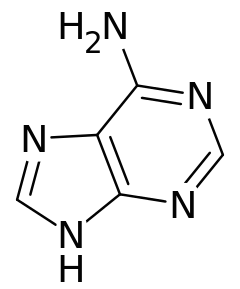
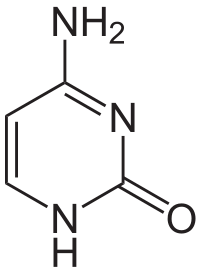
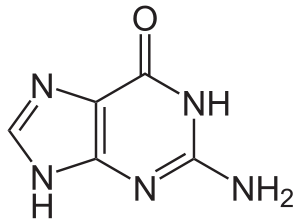
The four nucleotide bases of DNA - A, T, C, G - are each given a sound.
Even though they look fairly
similar to the amino acids shown below, and they're about the same size,
their importance lies in the information
they carry in their sequence
(for example, the start codon ATG), rather than their physical structure.
As a mnemonic, each sound is made from a different kind of instrument:
A (adenine) is a metal bell
T (thymine) is a wooden guiro (made from a tree)
C (cytosine) is a ceramic vase
G (guanine) is a wine glass
The two larger molecules, A and G, have sounds with a long decay, to signify their greater size;
the two smaller molecules, T and C, are staccato.
Also, A/T and C/G are bound together to create the double helix; but the A/T bond is not as strong, so those
sounds (bell and guiro) have a softer onset than C and G (ceramic and glass).
Finally, when DNA is transcribed to RNA, T is replaced with U (uracil); this is why the guiro (T)
sounds so different from the other three sounds.
Click each image below to hear its corresponding sound.
DNA
A (adenine)
metal
T (thymine)
wood
C (cytosine)
ceramic
G (guanine)
glass
You can make your own
DNA sonifications, to sonify any gene or sequence of DNA or RNA.
Amino Acids
Coded for by the four DNA bases, the twenty amino acids below fit
together, like Lego blocks, to build proteins. Each amino acids is given a pitch,
based on this Wikipedia article on
hydrophobicity scales,
going from low (hydrophobic, light green) to high (hydrophilic, purple).
The only exception are the acids that end with a ring of atoms, like W (tryptophan),
Y (tyrosine), F (phenylalanine) and P (proline);
these molecules are represented by two-note chords (dyads).
The electrically charged hydrophilic acids have long decays (like a harp),
while hydrophobic acids have an "oily" sound, like a violin bowed with the wood of the bow (col legno).
Amino acids - special cases
G Glycine
(no side chain; just a single note)
P Proline
(a single ring, played as a chord)
Hydrophilic amino acids with polar uncharged side chains - ascending
S Serine
T Threonine
N Asparagine
Q Glutamine
Hydrophilic with positively charged side chains - with reverb
H Histidine
R Arginine
K Lysine
Negatively charged - more reverb
D Aspartic Acid
E Glutamic Acid
Amino acids with hydrophobic side chains - descending